
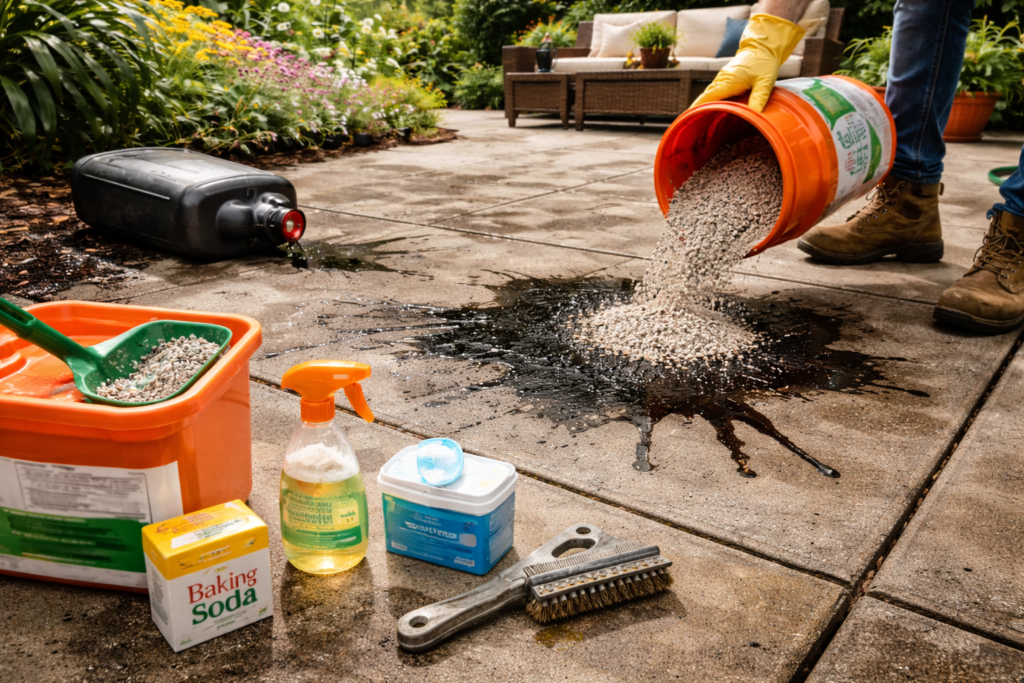
Oil stains on concrete have a special talent for ruining a patio. One quick drip under the grill, a small leak from a mower, or a careless oil change, and you’re left with a dark spot that looks permanent. The frustrating part is that concrete can look clean after a rinse, then that stain shows up again the moment it dries.
Here’s what’s really happening: concrete is porous. Oil doesn’t just sit on the surface. It seeps into tiny holes and binds to the cement and aggregate. That’s why “soap and a hose” almost never solves it, and why blasting with a pressure washer can make things worse if you don’t treat the stain first.
This guide walks you through a proven, step-by-step way to remove oil stains from a Concrete Patio. You’ll learn what to do immediately after a spill, how to treat old set-in stains, when to use a degreaser versus a poultice, and how to avoid patchy results. You’ll also get prevention tips so the same stains don’t keep returning in the exact same spots.
Before You Start: Fresh Oil vs Old Oil (They Need Different Tactics)
The biggest factor in how hard this will be is time. Fresh oil stains are mostly about quick absorption and controlled cleaning. Old stains are about pulling oil out of pores and lifting discoloration without damaging the surface.
- Fresh spill (minutes to hours): Absorb first, then degrease and rinse. You have the best chance of full removal.
- Recent stain (days to weeks): Degreaser plus scrubbing may work, but you may need multiple rounds.
- Old stain (months to years): You often need a poultice to draw oil out as it dries, then follow with cleaning and repeat if needed.
Also take a quick look at your patio type. Plain broom-finish concrete is generally forgiving. Stamped, colored, coated, or previously sealed concrete can react differently to strong cleaners. If the patio has an old sealer, you may get uneven results because some areas absorb cleaner and water differently.
Safety and Setup (And Don’t Skip This Part)
Degreasers and poultice materials can irritate skin and eyes, and runoff can stress nearby plants. A few minutes of setup makes the work cleaner and safer.
- Remove furniture, mats, and planters so you can treat the full stain area.
- Sweep thoroughly to remove grit that can scratch when you scrub.
- Pre-wet nearby plants and soil with clean water.
- Wear gloves and eye protection. If you’re using a sprayer, a simple mask is smart too.
- Work in calm weather so overspray stays where you want it.
If your patio drains toward a gutter or storm drain, keep products controlled and avoid letting concentrated degreaser run off. Use minimal product, follow labels, and rinse thoroughly.
What You’ll Need
You don’t need a garage full of supplies. You do need the right basics: absorption for fresh spills, a degreaser for breakdown, and (for stubborn stains) a poultice to pull oil up from the pores.
Basic tools
- Broom or leaf blower
- Stiff nylon brush
- Bucket and garden hose with spray nozzle
- Gloves and eye protection
For fresh spills
- Absorbent material (kitty litter, oil absorbent, or baking soda)
- Dustpan and bag for disposal
For cleaning and stain removal
- Concrete-safe degreaser (store-bought is usually more effective than dish soap)
- Pump sprayer or watering can for even application
- Poultice material for deep stains (details below)
Optional but helpful
- Wet/dry vacuum for pulling dirty water from low spots
- Pressure washer (used carefully) or surface cleaner attachment
- Plastic sheet to cover a poultice while it works
Step-by-Step: How to Remove Oil Stains from Concrete
This core method works in real life because it follows the right order: absorb what you can, break down what remains, scrub to lift it from the texture, then rinse until nothing soapy or oily is left behind.
Step 1: Absorb the oil (especially for fresh spills)
If the oil is still wet, start here. Don’t wipe it with a rag. That spreads it and pushes it deeper. Instead, cover the stain with absorbent material and let it sit.
- For a fresh puddle: pour absorbent generously and leave it for at least 30–60 minutes.
- For a thin slick: cover it anyway and give it time to pull oil out of the surface.
Once the absorbent darkens, sweep it up and dispose of it properly. If the stain was heavy, repeat once more. Absorption is your easiest win. Every bit of oil removed here makes the rest of the job easier.
Step 2: Pre-wet the concrete around the stain
Lightly wet the surrounding area first. This helps prevent the degreaser from instantly soaking deep into dry concrete and reduces the chance of creating a “clean ring” effect where only the center gets treated.
You want the surface damp, not flooded. Standing water can dilute the degreaser too much.
Step 3: Apply a concrete-safe degreaser (even coverage matters)
Use a degreaser labeled for concrete. Dish soap can help on very light stains, but it typically won’t break down motor oil or thick grill grease well enough.
Apply the degreaser evenly over the stain and slightly beyond it. Oil spreads in pores, so the visible spot is not always the full area that’s contaminated.
Step 4: Let it dwell (do not rush this)
Degreasers need time to emulsify oil, meaning they separate it so it can rinse away. Most products need about 10–15 minutes, but follow the label. Keep it wet while it dwells. If it starts to dry, lightly mist it with water.
Drying early is one of the main reasons people see no improvement and assume “nothing works.”
Step 5: Scrub firmly with a stiff nylon brush
Concrete has texture. Scrubbing helps lift oil from that texture and keeps it suspended in the cleaner. Scrub in overlapping circles, then do a second pass in straight lines. Pay extra attention to edges of the stain.
If the patio is decorative (stamped or colored), use firm pressure but avoid abrasive tools that can scratch or dull the finish.
Step 6: Rinse thoroughly and remove dirty runoff
Rinse from the outside toward the center, then rinse out from the center toward the drain direction. Keep water moving. The goal is to rinse away the emulsified oil and leftover cleaner, not spread it into clean sections.
If you have low spots where dirty water pools, use a wet/dry vacuum or push it out with a broom so it doesn’t settle back into the concrete.
Step 7: Let it dry and reassess
Concrete can hide stains while wet. Once dry, you’ll see the real progress. If the stain is lighter but still visible, that’s normal. Many oil stains improve in stages. Plan for at least two treatments on anything that’s been sitting for more than a few days.
When Degreaser Isn’t Enough: Use a Poultice for Deep Oil Stains
If the stain is old, dark, or has been baked in by sun and time, a degreaser may clean the surface but leave a shadow. That usually means oil remains below the top layer of the concrete.
A poultice is a paste that pulls oil up and out as it dries. Think of it as a “drawing” method rather than a “washing” method. It takes longer, but it’s one of the most effective options for stubborn stains.
What you can use for a poultice
- Commercial poultice products: easiest and most consistent results for severe stains
- DIY poultice base: baking soda, diatomaceous earth, or powdered clay
- Activator: a concrete-safe degreaser or solvent recommended for oil stains (test first)
How to apply a poultice
- Clean the area lightly first and let it become damp, not soaked.
- Mix your poultice into a thick paste (like peanut butter consistency).
- Spread it 1/4 to 1/2 inch thick over the stain, extending slightly beyond the edge.
- Cover loosely with plastic (optional). This slows drying and improves draw time.
- Let it sit until fully dry. This can take 24–48 hours depending on weather.
- Scrape up the dried poultice, then rinse and inspect after drying.
If the stain is still visible, repeat. Poultices often work best in multiple cycles, each pulling a little more oil out. It’s slower than pressure washing, but much more effective on stains that have penetrated deeply.
Pressure Washing and Oil Stains: Helpful, But Only at the Right Time
Pressure washing can rinse away loosened grime, but it doesn’t “erase” oil stains by itself. If you blast oil without breaking it down first, you can drive it deeper or spread it into a larger area.
When pressure washing can help
- After degreasing, to rinse away emulsified oil and residue
- After a poultice is removed, to clean remaining powder and surface film
- When you use a wide fan tip and keep consistent distance
How to avoid damage and streaks
- Use a wide fan tip (25° or 40°), not a zero-degree nozzle.
- Keep the wand moving. Never linger in one spot.
- Start farther away and adjust slowly.
- Consider a surface cleaner attachment to reduce zebra-striping.
- Test in a small, hidden area first.
If your patio has old, patchy sealer, pressure washing can make the surface look uneven because some areas rinse differently than others. In that situation, focus on controlled chemical cleaning and even rinsing instead of high pressure.
Common Oil-Stain Problems (And How to Fix Them)
“The stain got lighter, but it won’t disappear”
That usually means oil is still in the pores. Switch from degreaser-only to a poultice method, or repeat degreasing with longer dwell time and better scrubbing. Old stains are often a process, not a one-and-done job.
“Now there’s a clean spot that looks different than the rest of the patio”
This happens when you spot-clean aggressively on a patio that has overall grime or oxidation. The fix is simple: do a light, even wash of the entire patio so the color blends. Often the “clean patch” is a sign that the rest of the patio needs a general clean.
“The stain spread after rinsing”
That usually means the oil wasn’t fully broken down before rinsing. Next time, increase dwell time, scrub more thoroughly, and rinse with controlled flow from clean areas toward the stain, then off the patio.
“The stain is from grill grease, not motor oil”
Grill grease can be just as stubborn, sometimes worse because it mixes with soot and food residue. The same method works, but you may need a stronger degreaser and a second treatment.
Should You Seal the Patio After Removing Oil Stains?
Sealing can help a lot if your patio is prone to oil drips (grills, outdoor kitchens, equipment storage). A quality sealer reduces absorption, making spills easier to wipe and preventing deep penetration.
The catch is timing. Do not seal until the stain work is done and the concrete is fully dry. Sealing over remaining oil can lock in discoloration, and sealing over moisture can cause hazing or peeling.
Simple sealing tips
- Choose a sealer suited to your patio type (plain, stamped, colored, previously sealed).
- Test a small area first. Some sealers darken concrete slightly.
- Apply thin, even coats. Thick coats are more likely to haze or peel.
- Allow full cure time before putting furniture and grills back.
How to Prevent Oil Stains on a Concrete Patio
Prevention is simple, but most people skip it until the second or third stain shows up. If you use your patio around grills, tools, or outdoor equipment, a few small habits make a big difference.
- Use a grill mat under the grill and grease drip zone.
- Address leaks quickly from mowers, trimmers, or stored equipment.
- Keep absorbent on hand so fresh spills don’t soak in.
- Rinse lightly after greasy cooking if you notice splatter or drips.
- Consider sealing if your patio frequently sees oil exposure.
The faster you treat a spill, the better the outcome. Fresh oil is a cleanup problem. Old oil is a restoration project.
Quick FAQ
Can dish soap remove oil stains from concrete?
Dish soap can help with light surface grease, but it usually isn’t strong enough for motor oil or deep stains. It’s fine as a first attempt on small, fresh drips, but a concrete-safe degreaser is the better tool for real stains.
How many times do I need to treat an oil stain?
Fresh stains may clean up in one pass. Older stains often need two to four treatments, especially if oil has been sitting for months. If progress stalls after degreasing, switch to a poultice method to pull oil out of the pores.
Will pressure washing remove oil stains?
Not by itself. Pressure washing is best used as a rinse step after degreasing or poultice treatment. Without chemical breakdown first, pressure can spread oil or drive it deeper.
Why does the stain look worse when the concrete is wet?
Wet concrete can make oil-stained areas appear darker because water changes how light reflects in the pores. Always judge results after the surface dries completely.