Blog · May 19, 2026
How to Clean a Concrete Patio: Step-by-Step Guide

Marcus Reyes — Senior Cleaning Guides Editor, 10+ years in exterior cleaning & concrete care.
The first patio I ever ruined was my own. I cranked a 4,000 PSI machine to its narrowest tip, held it two inches off the slab, and carved a set of clean stripes into the concrete that are still there fifteen years later. That mistake taught me more than any job since: cleaning a concrete patio is less about brute force and more about reading the surface, matching the method to the stain, and knowing when to back off. Do it right and your slab looks years younger in an afternoon. Do it wrong and you etch permanent waves into it. This guide walks you through the whole job the way I'd run it on a crew, step by step.
Tools and supplies you'll actually need
You don't need a truck full of gear to clean a patio. Most jobs come down to a handful of basics, plus one or two stain-specific products. Here's the working kit:
- Stiff push broom with a wide head for sweeping and for scrubbing cleaner into the surface.
- Stiff-bristle deck or scrub brush on a pole for spot work on stains.
- Garden hose with an adjustable nozzle, or a pressure washer rated for the job (more on PSI below).
- A bucket and a pump or tank sprayer for mixing and applying cleaners evenly.
- Cleaners by stain type: a basic dish soap or concrete cleaner for grime, oxygen bleach (sodium percarbonate) for algae and mold, a citrus or alkaline degreaser for oil, and an oxalic-acid cleaner for rust.
- PPE: safety glasses, chemical-resistant gloves, closed-toe non-slip shoes, and long sleeves. Wet slabs and chemical splash are the two things that hurt people on these jobs.
- Plastic sheeting or tarps to protect nearby plants, siding, and furniture.
If you're trying to decide between buying gear and hiring out, our concrete patio cleaning cost guide breaks down what a pro typically charges versus what a DIY day actually costs once you factor in chemicals and a rented machine.
Step 1: Clear and prep the surface
Cleaning starts before any water touches the slab. Move all furniture, planters, grills, and rugs completely off the patio, not just to one side. Anything you leave behind becomes an obstacle that traps grime, blocks even cleaning, and gets blasted with chemical overspray.
Once it's clear, sweep the entire surface with the push broom. Get every leaf, twig, and pile of dirt off, and pay special attention to the cracks between sections and along the house. Loose debris that you leave behind just turns to mud the moment you wet it and ends up smeared back across the concrete. A genuinely good dry sweep makes the wet work twice as effective.
This is also the moment to inspect the slab. Note where the heavy stains are, whether you're dealing with green algae film, black mold spots, dark oil shadows, rust streaks, or that chalky white efflorescence. Knowing the enemy tells you which cleaner to reach for. If you're curious about how those stains form in the first place, we cover the chemistry and the climate factors in why concrete patios get dirty.
Step 2: Pre-wet and protect the surroundings
Before applying any cleaner, soak the surrounding landscaping. Give nearby grass, flower beds, and shrubs a thorough drink of plain water. Plants take up clean water first, which dilutes any cleaner runoff that reaches their roots and dramatically lowers the chance of burning them. Drape plastic sheeting over plants you can't move and over the lower courses of siding if you're working close to the house.
Then pre-wet the concrete itself. A damp slab keeps cleaner from soaking too deep, helps it spread evenly, and prevents streaky drying. Skip this step and your cleaner dries in patches before it can work. Wet the concrete until it's uniformly damp but not pooling.
Step 3: Choose your method by stain type
This is where most people go wrong. There's no single cleaner that handles everything, and using the wrong one wastes a Saturday. Match the product to what you're actually looking at.
General grime and dirt
For everyday buildup, dust, and traffic film, a simple solution of dish soap or a general concrete cleaner in warm water does the job. Apply it, let it sit a few minutes so it can loosen the grime, then scrub with the push broom working in sections. Soap and elbow grease handle far more than people expect.
Algae, mold, and mildew
That green or black film thriving in shady, damp corners is biological growth, and it needs a product that kills it rather than just rinsing the surface. Oxygen bleach (sodium percarbonate) mixed with warm water is my go-to: it's effective, far gentler on plants and concrete than chlorine bleach, and it doesn't leave the harsh fumes. Apply, let it dwell 15 to 20 minutes, scrub, and rinse. For widespread growth on a large or delicate slab, a low-pressure soft wash with the right solution is the better route. For a deeper walkthrough, see how to remove mold from a concrete patio.
Oil and grease stains
Fresh oil should be blotted and covered with an absorbent like cat litter or baking soda before you do anything else. For set-in stains, scrub a degreaser into the spot and let it dwell. Stubborn, deep stains often need a poultice, which is a paste that draws the oil up and out of the pores over a day or two. Oil is the most patience-dependent stain there is. Our full method lives at removing oil stains from a concrete patio.
Rust stains
Rust from metal furniture, fertilizer, or well water won't budge for soap or bleach. You need an acid, specifically an oxalic-acid-based rust remover. Apply per the label, give it time to react, then scrub and rinse thoroughly. Wear gloves and eye protection without exception. Never reach for muriatic acid as a first move; it's far harsher than the job needs and will etch the concrete.
Efflorescence
Those chalky white mineral deposits are salts that migrate to the surface as moisture evaporates. Light efflorescence often brushes off dry. Heavier buildup responds to a specialized efflorescence cleaner or a diluted acidic cleaner. Pre-wet first so the acid works on the surface deposits rather than soaking into the slab, and rinse well.
Step 4: Pressure wash vs. soft wash
This is the decision that protects or wrecks your concrete, so it's worth slowing down for. Both methods have their place, and the right call depends on the slab and the stain.
Pressure washing
Pressure washing uses high-pressure water to physically blast contaminants off the surface. For solid, healthy concrete it's fast and satisfying. The numbers that matter:
- Use 1,500 to 3,000 PSI. That range cleans concrete effectively without chewing it up. Older or softer slabs sit at the lower end; sound, newer concrete tolerates the higher end.
- Choose the right nozzle. A 25-degree (green) or 40-degree (white) tip spreads the force out. Never use a 0-degree (red) tip on a patio; it concentrates all that pressure into a pinpoint and will gouge the surface.
- Keep the wand moving and at distance. Hold the tip 8 to 12 inches off the surface and sweep in steady, overlapping passes. Pausing in one spot leaves a clean halo surrounded by dirt, and that uneven "striping" is permanent.
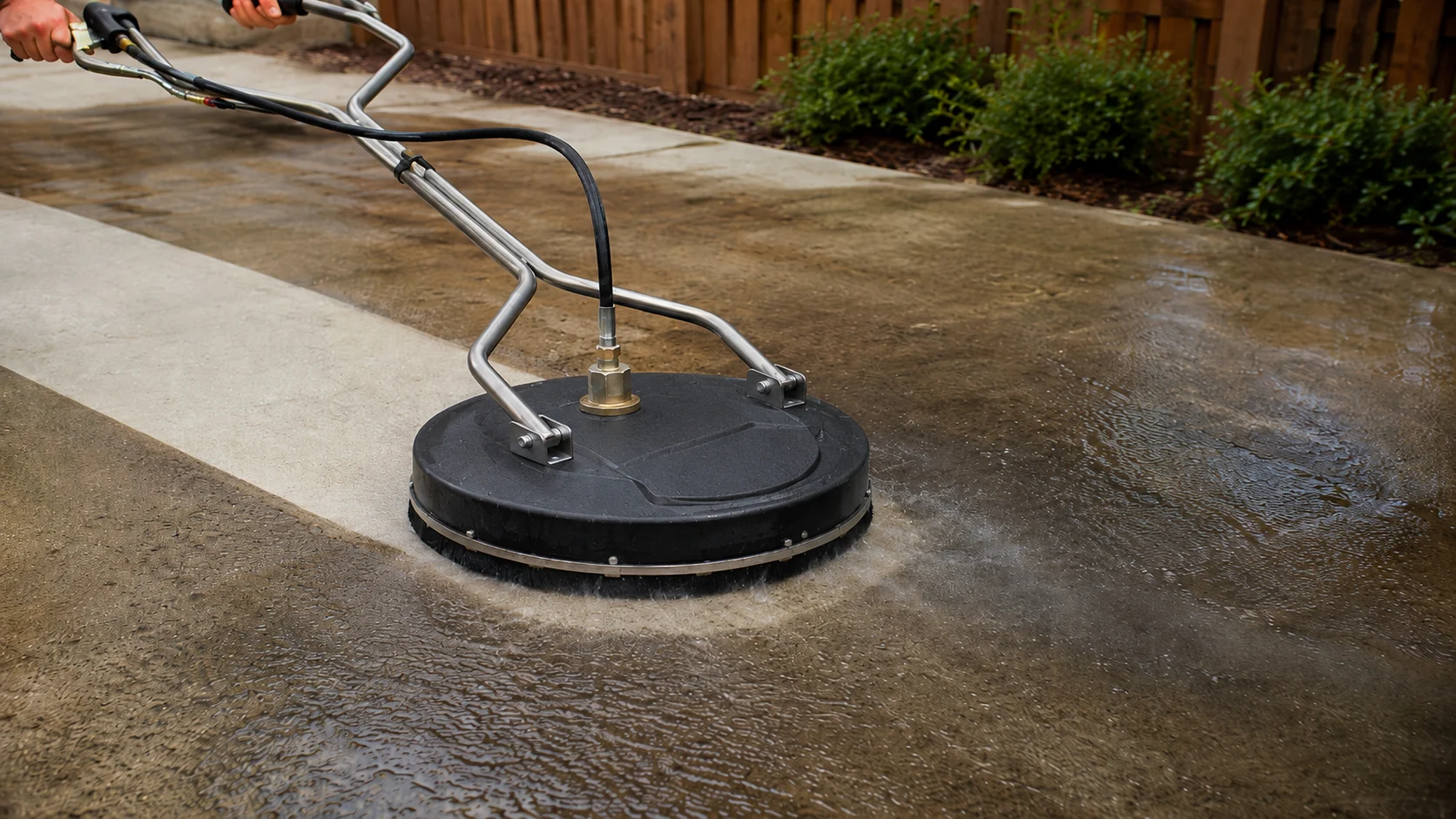
- Consider a surface cleaner attachment. That round, spinning attachment delivers even pressure across a wide path and is the single best way to avoid streaks on a big slab.
- Test an inconspicuous corner first to confirm your pressure and distance aren't etching before you commit to the whole patio.
Soft washing
Soft washing flips the formula: low pressure, smart chemistry. Instead of blasting, you let cleaning solutions do the work, then rinse at a gentle pressure. It's the right choice for algae and mold (it kills the growth at the root so it doesn't grow back as fast), for older or decorative concrete, and for any slab where you're worried about etching. Pressure washing removes what's on top; soft washing treats the problem. When growth keeps coming back, soft washing is usually why the pros get a longer-lasting result.
Step 5: Rinse and dry
However you cleaned, rinse the entire slab thoroughly with clean water, working from the high side toward the drainage so dirty water and cleaner residue run off and away from your house and plant beds. Leftover cleaner can leave a film, attract dirt, or harm landscaping, so don't shortcut the rinse.
Then let it dry completely. Sun and airflow do the work. Drying time matters because it sets up your next decision: whether to seal. In a humid Gulf climate, give the slab a full day of dry, sunny weather before you even think about sealer.
Step 6: Sealing (why, what, and when)
Sealing is the step most people skip, and it's the one that makes all your work last. A sealer fills the pores of the concrete so water, oil, and stains can't soak in, which means future cleaning is faster and growth has a harder time taking hold. In a wet, humid climate it's the difference between cleaning once a year and fighting algae every month.
There are two broad families. Penetrating sealers (silanes, siloxanes) soak in and protect from within while leaving the natural look and a non-slip surface. Film-forming sealers (acrylics, epoxies) sit on top and give a wet-look sheen, but they can get slick when wet and need reapplication more often. For a typical backyard patio, a penetrating sealer is the safer, lower-maintenance choice.
Timing is critical. The concrete must be completely dry, which usually means waiting 24 to 48 hours after cleaning, longer if humidity is high. Sealing over trapped moisture causes a cloudy, peeling finish. Check the weather and pick a dry, mild stretch with no rain forecast for at least 24 hours after you apply.
A realistic maintenance schedule for humid, Gulf climates
If you live along the Gulf Coast, you already know your patio fights a year-round battle with humidity, rain, and shade. Here's the rhythm I recommend for slabs in that climate:
- Weekly: sweep off leaves and debris. Organic matter holds moisture and feeds algae, so keeping the surface clear is your cheapest defense.
- Monthly: spot-treat any algae or mold the moment it appears, especially in shaded corners. A small problem caught early never becomes a full re-clean.
- Twice a year: a full cleaning, typically once in spring and once in fall, to stay ahead of seasonal growth.
- Every 1 to 3 years: reapply sealer. Penetrating sealers last longer; film-formers need it more often. If water stops beading on the surface, it's time.
Costs for a professional clean vary a lot by city and slab size. You can pull a free per-city estimate from our cost calculator for places like Katy and Sugar Land, or see the broader picture across Fort Bend County. DIY makes sense for routine maintenance and light grime. But when you're staring at deep oil, widespread mold over a large slab, or anything that needs serious pressure-washing technique, a vetted local pro with a surface cleaner and the right chemistry will get a better, safer result, and usually faster than you'd manage solo.
Safety: the part nobody regrets taking seriously
Two things hurt people on these jobs: chemicals and slick surfaces. Always wear gloves and eye protection when handling cleaners, never mix products (bleach and acid together create toxic gas), and work in ventilated conditions. A wet, freshly cleaned slab is genuinely slippery, so watch your footing, and a pressure-washer wand can break skin at close range, so keep it pointed down and away from feet. Read every product label, and when a stain or a slab is beyond your comfort level, calling a pro isn't a failure. It's the move that keeps your patio, and you, intact.
Common questions
Frequently asked
Can I use a pressure washer on a concrete patio?+
Yes, concrete handles pressure washing well as long as you use the right settings. Stay between 1,500 and 3,000 PSI, use a 25- or 40-degree nozzle (never the 0-degree red tip), keep the wand 8 to 12 inches away, and sweep in steady overlapping passes. Pausing in one spot or using too narrow a tip will etch permanent stripes into the surface.
What PSI should I use to clean concrete?+
Aim for 1,500 to 3,000 PSI. Older or softer slabs do better near the lower end, while sound, newer concrete tolerates the higher end. The nozzle angle matters as much as the number: a wider 25- or 40-degree tip spreads the force out and protects the surface. A surface cleaner attachment delivers the most even result on large patios.
Should I seal my concrete patio after cleaning?+
Sealing is highly recommended, especially in humid climates. It fills the concrete's pores so water, oil, and stains can't soak in, which makes future cleaning easier and slows algae growth. Wait until the slab is completely dry, usually 24 to 48 hours after cleaning, and apply during a dry, rain-free stretch for the best bond.
How often should I clean a concrete patio?+
In a humid, Gulf-style climate, do a full cleaning twice a year, typically spring and fall. Between those, sweep weekly and spot-treat any algae or mold as soon as it appears. Reseal every one to three years depending on the sealer type. Catching small stains early prevents them from turning into a full re-cleaning job.
Marcus Reyes · Senior Cleaning Guides Editor
Marcus Reyes spent over a decade in residential exterior cleaning and concrete surface care before moving into editorial work. He came up running pressure-washing and soft-wash crews across the Gulf Coast, where he handled everything from algae-covered patios to set-in oil stains and sealing jobs in high-humidity conditions. He now writes and edits Concrete Patio Cleaning's how-to library, translating field experience into plain-language guidance homeowners can actually use. Marcus focuses on what works, what damages a surface, and when a job is genuinely worth hiring out — drawing on the hands-on trade-offs he learned on the job rather than theory.
Background: 10+ years hands-on residential pressure-washing, soft-wash, and concrete sealing.