Blog · May 16, 2026
How to Remove Mold and Algae From a Concrete Patio

Marcus Reyes — Senior Cleaning Guides Editor, 10+ years in exterior cleaning & concrete care.
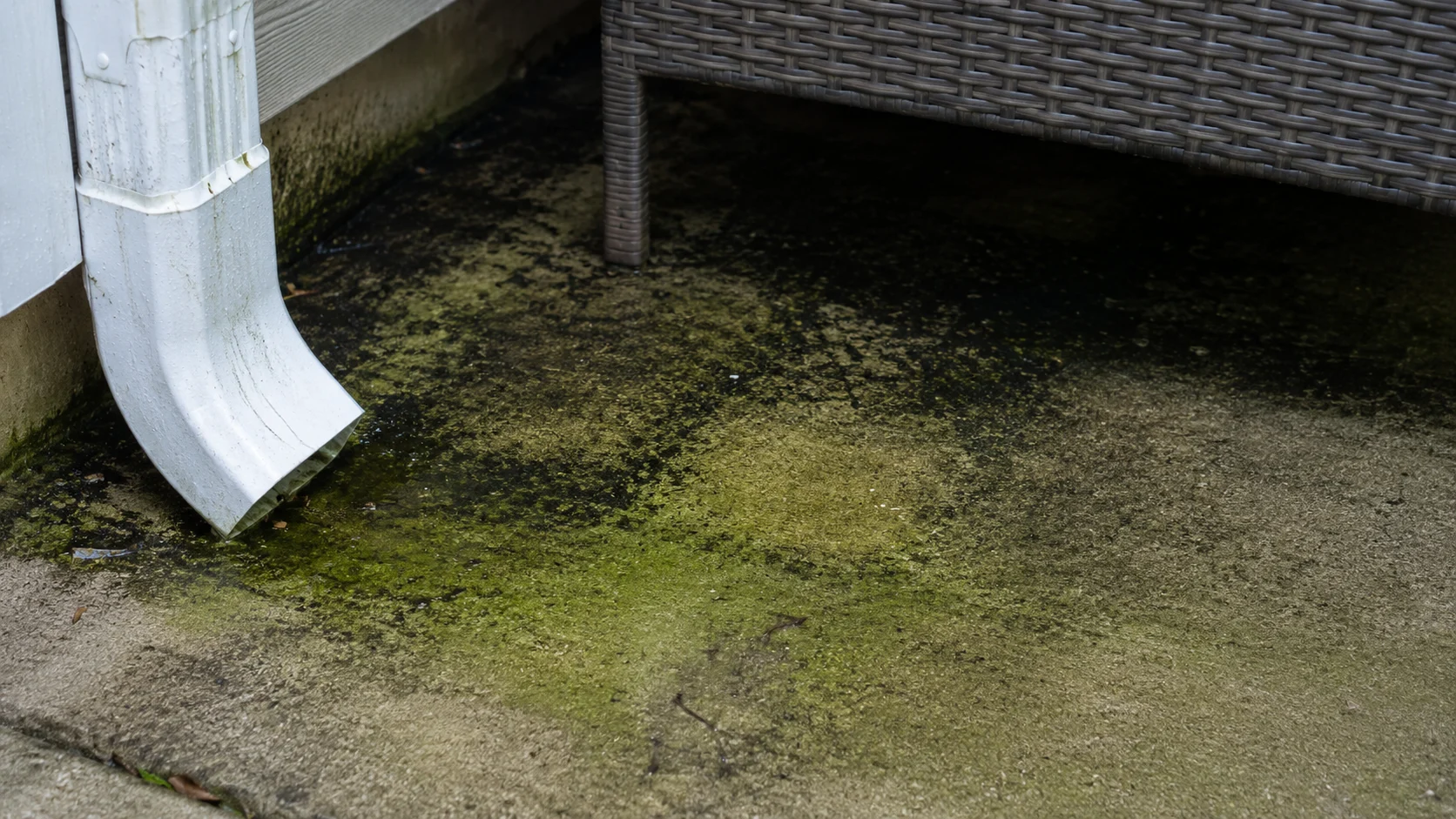
Walk onto a north-facing concrete patio in August and you can usually read the whole story underfoot. There's a green film along the slab edge where the sprinkler overspray lands, a darker gray-black staining under the patio table where the sun never reaches, and a slick, almost soapy patch by the downspout that nearly took your heel out from under you. I spent years running pressure-washing and soft-wash crews on the Gulf Coast, and that patio is the single most common job we got called for. It looks like one big stain, but it's actually three or four different living things, and they don't all respond to the same treatment.
If you reach for the wrong product, you'll spend a Saturday scrubbing, watch the patio look great for two weeks, and then watch the green come right back. Below is how to tell what you're actually dealing with, the DIY methods that work (and the ones that mostly don't), how the pros kill it at the root with soft washing, and how to keep it from returning. This is general guidance for slabs and walkways; the same biology shows up on driveways too, so most of it carries over.
First, Identify What You're Looking At
People use "mold," "mildew," and "algae" interchangeably, but on a concrete patio they're different organisms with different behavior. Getting the ID right tells you how aggressive your chemistry needs to be.
Green algae
That bright-to-dark green film is the most common growth on patios, and it's true algae. It thrives anywhere it gets moisture and a little light: along slab edges, under hose bibs, around planters, wherever sprinkler overspray hits. Green algae sits on the surface as a thin biofilm, which is good news. It's the easiest of the bunch to remove and the most responsive to gentle chemistry. The bad news is it's also the fastest to come back if the moisture source stays.
Black algae (Gloeocapsa magma)
The gray-to-black streaking and staining people swear is "mold" is usually Gloeocapsa magma, a cyanobacteria. It's the same organism that causes the black streaks on roof shingles. It produces a dark protective sheath to shield itself from UV, which is exactly why it survives in sun and why scrubbing alone barely touches it. Black algae roots into the porous surface of concrete. You have to kill it, not just abrade it, or it regrows from what's left behind.
Mildew and mold
Mildew is a surface fungus, typically gray, white, or light brown, and powdery or fuzzy. It loves shade, trapped humidity, and organic debris like leaf litter or pollen film. Mold is fuzzier, can be black, green, or even orange, and tends to show up where organic matter is actively decaying, like under a damp doormat, a rotting wood planter, or a perpetually wet corner. Mildew is genuinely easy to remove. Established mold can be more stubborn and is the one with the clearest health angle if you have respiratory sensitivity.
A quick field test: dab a little household bleach solution on a small spot. If it lightens to near-invisible in a minute or two, you're dealing with mildew or algae (organic). If it doesn't budge, you may be looking at a stain, efflorescence (white mineral deposit), or something embedded that isn't biological at all. For non-biological discoloration like grease, see our guide on oil stains on concrete, which is a completely different problem.
Why It Grows in the First Place
Concrete is porous and slightly alkaline, and it holds moisture far longer than people expect. Three conditions drive nearly every patio growth problem, and almost always more than one is present at once:
- Moisture that lingers. Poor drainage, sprinkler overspray, downspouts dumping onto the slab, a low spot that puddles after rain. Standing water is the single biggest factor.
- Shade and poor airflow. North-facing slabs, areas under deep eaves, patios boxed in by fences or dense landscaping. Without direct sun, the surface stays damp for hours longer.
- An organic food film. Pollen, dust, leaf tannins, tree sap, and grime build a thin layer that algae and mildew feed on. Concrete that's never washed accumulates this fast.
This is also why a patio in a humid climate grows back faster than the same patio up north. If you want the longer explanation of the conditions at play, we cover it in why concrete patios get dirty. The takeaway: you can clean the surface today, but if the moisture and shade stay, you're managing a recurring problem, not a one-time stain.
DIY Method 1: Oxygen Bleach (My Default Recommendation)
If I had to pick one product for a homeowner to keep on the shelf, it's oxygen bleach, sold as sodium percarbonate powder. When mixed with warm water it releases hydrogen peroxide, which breaks down organic growth without the harshness of chlorine. It's safe on most concrete, won't strip color the way chlorine can, won't corrode metal furniture or railings, and it's far gentler on surrounding grass and plantings. It's slower than chlorine, but it's the right tool for a planted patio.
Here's the process that works:
- Sweep the slab clean and clear furniture and planters off the area.
- Mix the sodium percarbonate per the label, usually a few ounces per gallon of warm water. Warm water activates it; cold water makes it sluggish.
- Pre-wet nearby plants and the slab itself so nothing dries out mid-job.
- Apply the solution generously and let it dwell 15 to 30 minutes. Do not let it dry out. Re-mist if needed. Dwell time is where the killing happens, so don't rush it.
- Scrub with a stiff-bristle deck brush, working in the direction of the broom finish. The growth should release as a gray or green slurry.
- Rinse thoroughly with a garden hose. A second light application on stubborn black-algae areas is normal.
For light green algae and mildew, one pass usually does it. For embedded black algae, expect to repeat and accept that the deep staining may fade rather than vanish on the first treatment.
DIY Method 2: Chlorine Bleach (Works, But Know the Tradeoffs)
Household chlorine bleach (sodium hypochlorite) genuinely kills algae, mildew, and mold. A common DIY mix is roughly one part bleach to three or four parts water with a tiny squirt of dish soap as a surfactant. Apply, let it dwell about 10 minutes, scrub, and rinse hard.
The cautions are real, though. Chlorine bleach will scorch and kill grass and plants it runs off onto, so you have to pre-wet and heavily rinse the surrounding landscape. It corrodes aluminum furniture, fasteners, and metal railings. It can lighten or blotch colored or stained concrete. And critically, never, ever mix it with vinegar, ammonia, or other cleaners; that produces toxic chlorine gas. Work in ventilation, wear gloves and eye protection, and keep pets and kids off until it's dry and rinsed.
The other thing crews learn quickly: surface-applied chlorine kills what it touches, but if it doesn't penetrate to the root of black algae in the concrete's pores, the growth returns fast, sometimes within weeks. That's the gap between a DIY splash-and-scrub and the way professionals apply it.
DIY Method 3: White Vinegar (Light Duty Only)
White vinegar gets recommended a lot online, and I want to be honest about it: it works on light, fresh mildew and a thin green film, and that's about it. The acetic acid is mild. Spray it undiluted or lightly cut, let it sit 15 minutes, scrub, and rinse. For a small shaded corner with early mildew, fine. For established black algae or a fully greened-over slab, vinegar will disappoint you. It's a spot treatment, not a patio-wide solution, and again, never combine it with bleach.
How the Pros Do It: Soft Washing
Here's the single most important concept in this whole article, and it's the one DIYers most often miss. The professional approach to patio algae and mold is soft washing: low pressure plus the right chemistry, not high pressure alone.
A soft-wash crew applies a measured sodium-hypochlorite solution (with a surfactant to help it cling and dwell), lets the chemistry kill the organism down into the pores, then rinses at low pressure. The reason this beats blasting is biological. A high-pressure washer can knock visible algae off the surface and make the patio look clean instantly, but it's essentially scattering live spores and root material that simply regrow, often faster, because you've just opened up the surface. Soft washing kills at the root, so the regrowth clock resets much further out. It also doesn't carve into the concrete.
That distinction, killing versus blasting, is why a professionally soft-washed patio stays clean for many months to a year-plus, while a pressure-washed-only patio can green up again by the next humid season. If you'd rather hand it off, you can see realistic local pricing on our patio cleaning cost guide, and we have a free calculator on every city page, including ones like The Woodlands, TX and Katy, TX, where humidity and shade make this a near-constant battle.
Pressure Washing: Use It Carefully
Pressure washing has a place, mainly for rinsing after chemistry has done the killing, or for general grime. But concrete is more vulnerable than it looks. Too much pressure or a too-narrow tip will etch the surface, leave wand marks and zebra striping, and strip the cement paste, leaving the slab rougher and more porous, which ironically makes future algae grow back faster. If you do use one:
- Use a 25-degree or wider tip, never a zero-degree (red) tip.
- Keep the nozzle 8 to 12 inches off the surface and keep it moving in even, overlapping passes.
- Apply your cleaner first and let it dwell. The chemistry does the work; the water just rinses.
- Test an inconspicuous corner before doing the whole slab.
For a full walkthrough of doing the job start to finish, see our guide on how to clean a concrete patio.
Health and Slip-Hazard Concerns
This isn't only a cosmetic issue. Algae and mildew make concrete genuinely slick, especially when wet, and a green-filmed patio by a pool or back step is a real fall hazard, particularly for older folks and kids. That alone is worth staying on top of. On the health side, mold and mildew can aggravate allergies and asthma, so wear an N95 and gloves when you're scrubbing a heavily affected area, and don't let a damp, moldy corner fester right outside a frequently used door.
Prevention: Keep It From Coming Back
Killing the growth is half the job. Removing the conditions that feed it is what actually keeps your patio clean. Focus here:
- Fix the moisture. Redirect downspouts off the slab, adjust sprinkler heads so they stop hitting the concrete, and address any low spot that puddles. This is the highest-leverage thing you can do.
- Improve sun and airflow. Trim back overhanging branches and dense shrubs so the slab dries faster and gets more direct light. A patio that dries within an hour of rain rarely greens over.
- Sweep regularly. Removing leaf litter, pollen, and debris starves the growth of its organic food film.
- Seal the concrete. A quality concrete sealer reduces porosity so algae has less to root into and makes routine cleaning far easier. Reapply per the product's schedule, typically every couple of years.
- Wash on a schedule. A light annual or twice-yearly cleaning, even just a gentle oxygen-bleach treatment, keeps growth from ever getting established. It's far less work than a full restoration.
Do those things and the once-a-year deep clean becomes a quick rinse. Skip them and you'll be back out there with a brush every spring. After years of doing this for a living, that's the real lesson: the slab isn't dirty so much as it's alive, and the win is changing the conditions so it stops wanting to grow.
Common questions
Frequently asked
Does bleach actually kill patio mold and algae?+
Yes. Both chlorine bleach (sodium hypochlorite) and oxygen bleach (sodium percarbonate) kill mold, mildew, and algae. The catch is reaching the root in the concrete's pores. A quick surface splash kills what it touches but often misses embedded black algae, which is why letting the solution dwell before scrubbing matters so much.
Why does the green and black growth keep coming back?+
Because the conditions that feed it are still there. Lingering moisture, shade, poor airflow, and an organic film let algae and mildew regrow within weeks. Pressure washing alone can scatter live spores that quickly return. Killing it with chemistry and then fixing drainage, sun exposure, and sealing is what makes it stay gone.
Is concrete patio algae dangerous or just ugly?+
It's both a slip hazard and a mild health concern. Algae and mildew make wet concrete genuinely slick, raising the risk of falls near pools and steps. Mold and mildew can also aggravate allergies and asthma, so wear an N95 and gloves when scrubbing heavily affected areas and keep damp, moldy corners cleared.
Should I use a pressure washer or hire a soft-wash service?+
For light grime, a careful pressure wash with a wide tip works. But for algae and black staining, soft washing (low pressure plus chemistry) kills at the root instead of blasting spores that regrow. High pressure can also etch concrete. If you'd rather not DIY, check local pricing on our cost guide and city-page calculators.
Marcus Reyes · Senior Cleaning Guides Editor
Marcus Reyes spent over a decade in residential exterior cleaning and concrete surface care before moving into editorial work. He came up running pressure-washing and soft-wash crews across the Gulf Coast, where he handled everything from algae-covered patios to set-in oil stains and sealing jobs in high-humidity conditions. He now writes and edits Concrete Patio Cleaning's how-to library, translating field experience into plain-language guidance homeowners can actually use. Marcus focuses on what works, what damages a surface, and when a job is genuinely worth hiring out — drawing on the hands-on trade-offs he learned on the job rather than theory.
Background: 10+ years hands-on residential pressure-washing, soft-wash, and concrete sealing.